Pro Trump Repeal of Clean Power Plan Law Review
The pro'south guide to the new cookie law (part 1)
What exactly is the cookie police?
The Privacy and Electronic Communications Regulation (PECR), more ordinarily known every bit the 'cookie law', is UK legislation designed to protect cyberspace users' privacy. It is one of five EU Electronic Communications Directives, which were required to exist implemented past all European union member states by 25 May 2011. Yeah, 2011 – only it caused so much confusion in the industry that the UK's regulator, the ICO, extended the borderline to 25 May 2012.
Richard Beaumont'southward 'A beginner'southward guide to the new cookie law', published on 23 May 2012, provided a fantastic overview of what spider web designers and developers should be thinking near. 3 months on, and although the furore has died down, the finer details of compliance and technical implementation are widely interpreted and inconsistent.
But it's more than just cookies
Although the focus has been around the utilise of cookies, the PECR covers other technologies that impact on users' privacy. These include:
- Third party services embedded into websites, such as YouTube
- Third party services integrated into websites through the utilize of APIs, such as social media
- Technologies that enable the reading and writing to a website, spider web application or mobile awarding's database
Of the greatest business organisation are the technologies used to store information on computers and mobile devices to runway behaviour.
In addition to cookies, other existing and emerging technologies that aid perform these functions include:
- Flash cookies or Flash locally stored objects
- HTML5 storage
- Web storage or DOM storage
- Indexed Database API or Indexed DB
- Local data storage in mobile applications
For simplicity's sake, we will refer to all technologies covered nether the PECR collectively as 'cookies'; for the same reason websites, web applications and mobile applications will be referred to collectively as 'websites'.

What's all the fuss about?
Cookies are well established in mainstream digital communications and are vital components of the internet eco-organisation. With well-nigh organisations using content management systems
(CMSes) to efficiently create, publish and manage website content and such systems embedding cookies' functionality in their core code, cookies have get an integral role of the way the modernistic web works.
Cookies were non created to invade or abuse privacy: because HTTP is a stateless protocol, cookies were designed to work alongside browsers, enabling HTTP to maintain land. As the web evolved, then did the use of cookies.
As far as the cookie constabulary goes, organisations that use cookies in ways that borrow users' privacy by serving unwanted or intrusive advertising and technologies that access and utilise personally identifiable information are the real culprits, merely the law focuses on the technology used and not what the technology is used for, so all cookies are deemed a threat to privacy. Just not and then.
What'due south the spider web industry doing about it?
As the web industry is not a cohesive one, at that place is no one vocalization, which has not made things any easier for spider web designers and developers who but want articulate guidance on what to implement.
Although there is broad agreement that the legislation is overkill, the ICO's approach to cookies has resulted in the real issues being diluted; instead of the interests of consumers being protected past providing them with the information they need to make informed choices, website owners hurried to meet the ICO's deadline in fearfulness of enforcement, with a variety of sticky plaster solutions, most that did not come across compliance requirements.
The trouble is that:
- Most organisations do not take the expertise in-house to fully comply.
- There is no manufacture-wide consensus on approach, interpretation or policy.
- There are no technical standards, norms or guidelines.
As a marketer and an abet for inclusive pattern, I take however to see a single solution that I don't find slow in one way or another, but the real business concern is that the cookie legislation appears to have been drafted in a vacuum. At nowadays there are simply no solutions to full compliance that are non in conflict with other legislation.
There are conflicts with several of the Data Protection Act's Principles, and not meeting accessibility standards conflicts with provisions nether the Equality Act. Moreover, with 96 per cent of Britain organisations employing nine people or less, the financial impact for SMEs must exist a consideration. Obtrusive technical implementations that erode UX will lead to loss of acquirement and, in improver to the costs of meeting compliance, this could atomic number 82 to SMEs falling foul of their obligations to shareholders under the Companies Act.
Even so, implementation on a site-by-site basis volition not solve the wider privacy problems that the internet faces; ensuring that users privacy and security are maintained across multiple digital channels must be an industry broad concern.
Not everyone is a take chances taker, but …
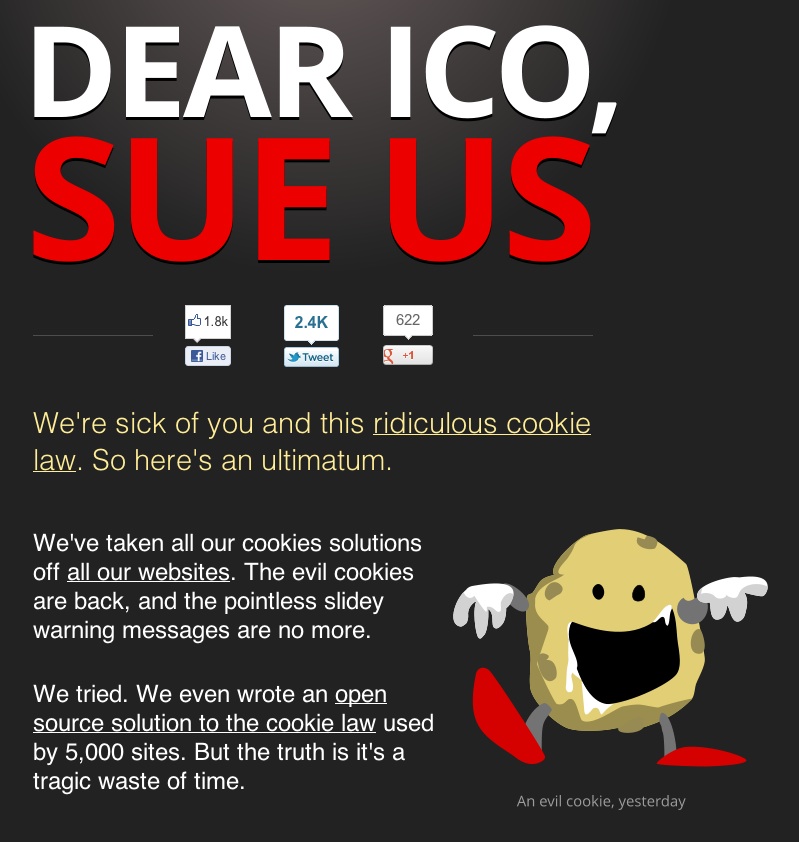
I take enjoyed watching how Silktide's assuming "DEAR ICO, SUE US" approach has played out, simply as .net is not here to dispense legal communication, this is not a recommendation. Nevertheless, Silktide has a point. Well several actually. It will be interesting to encounter what happens when the ICO responds fully, only in the meantime, as the rest of united states are probably not so bold we shall trudge through.
Will the ICO loosen the legislation then?
At present, the requirement for compliance past all UK website owners is absolute; the legislation makes no stardom between types of cookies, the purposes they are used for or the types of information they shop and applies blanket provisions. In the sew to the May 2012 deadline, although the ICO acknowledged the challenges faced by organisations seeking to comply, the guidance was woolly at best.
In April 2012, the UK Department for Culture, Media and Sport wrote an open letter to the ICO imploring information technology to consider a more concern led and pragmatic approach; this was quickly followed by the folk at GovUK, Regime'southward Digital Services section, publishing their guidelines, which were aligned with the DCMS's letter. The ICO's response was unsatisfactory – it stood its ground – but the Government's own non-compliance set a precedent.
The ICO's expectation was that industry would discover a unmarried solution, but none was forthcoming and and then in the final 60 minutes the ICO fabricated a pivotal change to the guidelines. Information technology relaxed how it volition regulate and apply penalties for those in alienation and, more than importantly, it introduced the option for implied consent to be accounted acceptable – in recognition of the use of session cookies as an industry norm.
Although Silktide'due south public challenge to the ICO is gaining momentum, the ICO isn't biting and has stated on its blog:
"…while some are still unclear around whether implied consent is immune, nosotros go on to piece of work to educate around this."
The ICO farther states that information technology is responding to consumer complaints and will publish a progress update in Nov.
And and so the cookie crumbles.
What are we expected to do correct now?
Then, for now, the ICO says organisations should exercise:
"....everything they tin can to become the right information to users and that they are allowing users to make informed choices almost what is stored on their device".
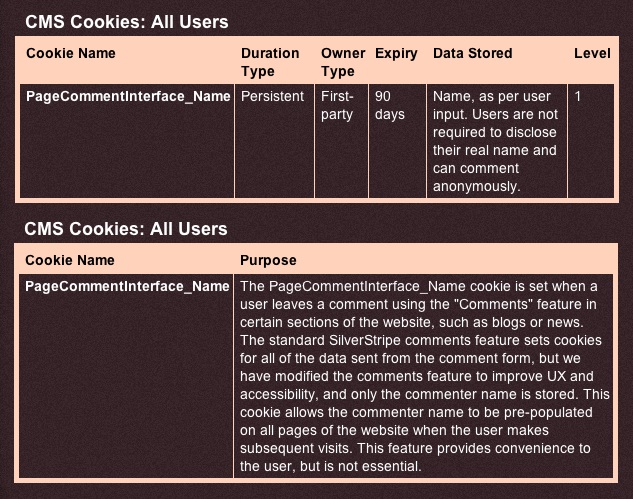
Clear every bit mud. The merely exemption being when the use of cookies is "strictly necessary", which is a term used by the ICO, simply is loosely divers and hotly debated. Put simply, if the cookie is required to protect user privacy and security, then it is strictly necessary. For all other uses, the probability of enforcement increases in line with the risk the cookie places of infringing on users' privacy.
Despite the disparity and confusion, it is not a skilful idea to just 'wait and come across'.
The quest for consent
One of the major changes the PECR brings is the requirement for websites to obtain consent from users to shop cookies on their devices. Initially, the ICO guidelines expected all consent to be obtained before any data was stored; the web industry heaved a huge sigh of relief when the ICO accustomed that this is not always possible and included unsaid consent in its guidance.
First party and analytical cookies
At this juncture, the ICO will deem it acceptable if websites use first party cookies:
- for not-intrusive functional or analytical purposes merely;
- properly inform users about what Cookies are being used; and
- asking consent as soon equally is reasonably practicable.
However, equally the legislation itself remains unchanged, this is not a get out of jail free carte du jour.
Third party cookies
If websites allow third parties to fix cookies on users' devices, the procedure of obtaining consent is considerably more than onerous, because website owners volition be asking users to accept cookies from other domains non in their command.
Prior vs implied consent
The ICO has taken into consideration that most websites set a session cookie as soon as a user accesses the website, in order to seamlessly enable the stateless HTTP protocol to laissez passer state data.
As such, if information technology is not possible or practical to obtain prior consent, websites should clearly demonstrate that they are doing everything they can to minimise the length of time between a cookie beingness assail a user's device and the user beingness able to access relevant data most cookies and being provided with options.
Soon implied consent is the most usually used mechanism, despite the ICO stressing that users would need to take the appropriate knowledge and agreement about cookies before the ICO could exist confident that implied consent is an effective method.

Can I merely plug and play?
At that place are no off-the-shelf solutions, merely upstanding organisations that don't use 3rd party cookies and just want to do the right thing need not fear. In advance of the ICO deadline, I led a multidisciplinary team advising on all aspects of the PECR – design, technical, marketing, legal, operational and so some. Yes, I am that wearisome – and the information in this article has been distilled from what I take learned.
Considering the likelihood of enforcement
Before jumping into the how-tos of implementation, one of the key things to appraise is the likelihood of enforcement. The ICO bases its decision on an assessment of risk, but I shall not bore you with the details of procedure
It is improbable that the ICO will have regulatory action if:
- at that place has been no apparent privacy detriment;
- you have satisfactorily reviewed Cookie use on your website, spider web application or mobile awarding;
- yous have satisfactorily informed users about the Cookies y'all apply;
- you lot accept enabled users to cull whether or not they take Cookies; and
- the user has not set their browser to reject Cookies.
Stuff all web designers and developers demand to know
Why websites apply cookies
The HyperText Transfer Protocol (HTTP), the means via which web pages are requested and delivered via the internet, intranet and other networks, is described as a 'stateless protocol', wherein every web page is requested and served in isolation. At that place is no provision in the HTTP protocol for the server receiving a request for a web folio to 'know' nearly whatsoever previous requests made to serve spider web pages to the requesting browser.
For websites that accept static pages only, this statelessness does not present an issue. All the same, as most websites, web applications and mobile applications are not static and have some level of user interaction, attributable to its stateless nature the HTTP protocol alone cannot facilitate user interaction.
On an ecommerce website, for someone to add a product to a shopping cart and so proceed to checkout, the technology must perform certain functions in a set sequence and in order to practise then, the system as a whole has to be stateful, and cookies are the most popular and efficient fashion of overcoming the shortfalls of HTTP.
How cookies work
Cookies provide a means whereby a server can take action. When the server receives a request to prepare a cookie, it takes action and does so. One time the cookie has been set, the server is able to have further action based on the value of the cookie, because the arrangement has become stateful.
From the user's perspective, the initial interaction occurs when the user requests a web page and their browser sends an HTTP asking to the server. The server responds past serving the spider web folio, with state data in the class of a cookie, which is embedded in the HTTP header of the response. The browser receives and renders the web folio and, assuming that the user has not changed settings so that cookies are non accepted, the Cookie data is stored on the user'due south device and filed under the domain of the server that sent it.
Subsequent interactions occur when the user requests some other web page from the aforementioned domain. The browser has a cookie filed for that domain, and inserts it into the HTTP request header earlier despatching it to the server. The server receives the request, 'knowing' about the previous request, owing to the presence of the Cookie in the new HTTP request header.
Cookie alternatives and why they are not used
It is untrue to say that no culling ways of passing state data exists: there are other technical means whereby the functionality of a cookie may be replicated. All the same, they are neither practical nor desirable; the cookie is far superior and offers a seamless and unobtrusive user experience.
Users anonymity cannot exist guaranteed
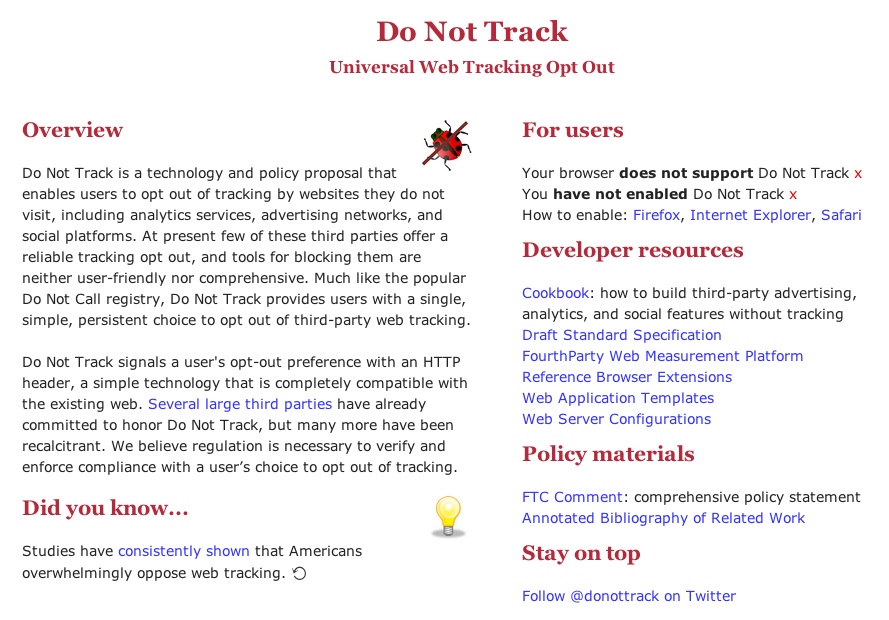
At present, there are no mechanisms that ensure total anonymity on the internet. Disabling cookies and using DNT volition not prevent people from beingness trackable. The utilize of a standard PC and browser avails the following data:
- IP Address
- Timezone the device is set to
- User preferences, such as screen resolution and color depth
- The fonts installed on the device
- Which browser is beingness used and on what device
- What browser extensions and plug-ins are installed on the device
- Whether the user has JavaScript turned on or off
- Whether the browser accepts cookies or not
Web standards, UX, accessibility and best practices
As I trawled through the lawmaking and techniques of the various technical solutions emerging to tackle consent, none met with the standards or best practices that we work to and this poses one of the biggest challenges for web designers and developers around cookies; although at that place are lots of interesting and creative solutions, most take been adult in isolation to provide a technical solution for cookie consent, in many instances this puts them in conflict with best practices for UX, web standards, accessibility guidelines and other legislation.
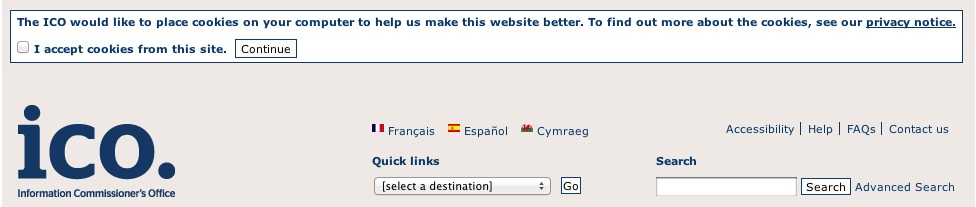
For example, the ICO uses CSS for absolute positioning of its opt-in overlay characteristic, so although it is visually prominent, the feature is actually at the end of the footer in the HTML. Keyboard-merely and screen reader users are unlikely to access the feature unless they navigate through an unabridged spider web page to the footer, then will be able to freely navigate through the ICO website without e'er having to opt in. If they did want to practice so, it is unlikely that they would be able to locate the fashion of access.
Coming up in part ii: implementation
Once you've assimilated the whys and the wherefores, office two volition provide all you demand to get downwardly to the how-tos of implementation, whether doing so in-house or using an agency. Yous'll exist equipped with indispensable knowledge, so that you can conduct a thorough cookie inspect, create a plan of activity, determine which route to implementation and technical solution is right for your website and exist able to manage how your website uses cookies as the ICO'southward approach to regulation evolves and technology changes over time.
In the meantime:
References and farther reading
European union Data Protection Framework
- EU Information Protection Directive
United kingdom of great britain and northern ireland legislation and guidance
- The Privacy and Electronic Communications (EC Directive) (Amendment) Regulations 2011
- ICO PECR Compliance Guidance
- ICO PECR Monetary Penalties Guidance
Manufacture resources
- How Google Analytics uses Cookies
- IAB European union ePrivacy Directive: Consumer Transparency Framework for Publishers / Affiliates
- W3C Blog: The state of Practise Not Track
Related articles
Source: https://www.creativebloq.com/netmag/pros-guide-new-cookie-law-part-1-9126083

Post a Comment for "Pro Trump Repeal of Clean Power Plan Law Review"