How Do Families With Modest Incomes Acquire Wealth
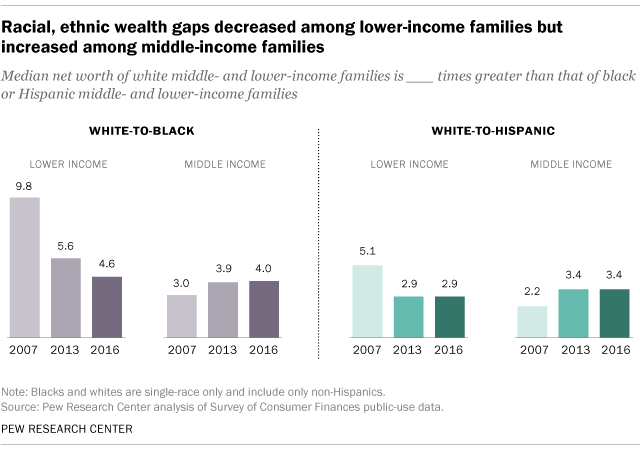
The Not bad Recession of 2007-2009 triggered a abrupt, prolonged turn down in the wealth of American families, and an already large wealth gap between white households and blackness and Hispanic households widened farther in its firsthand aftermath. But the racial and ethnic wealth gap has evolved differently for families at dissimilar income levels, according to a new Pew Research Center analysis of data from the Federal Reserve Board's Survey of Consumer Finances.
Amidst lower-income families, the gap betwixt white households and their black and Hispanic counterparts shrank by virtually half from 2007 to 2016. Just amidst heart-class families, it increased and shows no sign of retreating. (There are an insufficient number of observations in the SCF data to report on upper-income blackness and Hispanic families separately.)
 Overall, American household wealth has not fully recovered from the Great Recession. In 2016, the median wealth of all U.S. households was $97,300, upward 16% from 2013 merely well beneath median wealth earlier the recession began in late 2007 ($139,700 in 2016 dollars). And even though overall racial and ethnic inequality in wealth narrowed from 2013 to 2016, the gap remains large. In 2016, the median wealth of white households was $171,000. That'southward 10 times the wealth of black households ($17,100) – a larger gap than in 2007 – and viii times that of Hispanic households ($20,600), about the same gap as in 2007. (Asians and other racial groups are not separately identified in the SCF data.)
Here are some key trends in household wealth beyond income tiers and racial and ethnic groups.In this analysis, nosotros categorized families past their household income, later adjusting their incomes for family unit size. Middle-income families have size-adjusted incomes betwixt two-thirds and twice the national median size-adjusted income. Lower-income families have a size-adjusted household income less than 2-thirds the median and upper-income families more than than twice the median.
This analysis is based on data from the Federal Reserve Board's Survey of Consumer Finances (SCF), conducted triennially from 1983 to 2016 (updated October. 12, 2017). The surveys from 2007, 2010, 2013 and 2016 bridge the duration of the Swell Recession from Dec 2007 to June 2009 and the economic recovery thereafter.
The findings past race and ethnicity in this analysis are not comparable to previous analyses past Pew Research Eye due to revisions in the racial and ethnic classifications in the SCF. There are an bereft number of observations in the SCF information to report on upper-income black and Hispanic families separately. Too, Asians and other racial groups are not separately identified in the SCF data.
Wealth, or net worth, is the difference between the value of a family unit's assets (such every bit bank accounts, stocks, bonds, homes, cars and businesses) and its debts. Wealth is accumulated over time and differs from household income, or the almanac arrival of wages, interests, profits and other sources of earnings. Wealth gaps betwixt whites, blacks and Hispanics accept always been much greater than income gaps and provide an alternative perspective on racial and ethnic inequality in household well-existence.
In this assay, nosotros categorized families past their household income, after adjusting their incomes for family size. Heart-income families have size-adjusted incomes between two-thirds and twice the national median size-adapted income. Lower-income families take a size-adjusted household income less than two-thirds the median and upper-income families more than than twice the median.
For a family of iii in 2016, a household income of about $42,500 to $127,600 qualifies as middle income, based on SCF data. Lower-income households live on less than $42,500 and upper-income households earn more than $127,600. This methodology results in 47% of America'southward families being classified as middle income in 2016. Most i-third of families (32%) were lower income and 21% were upper income.
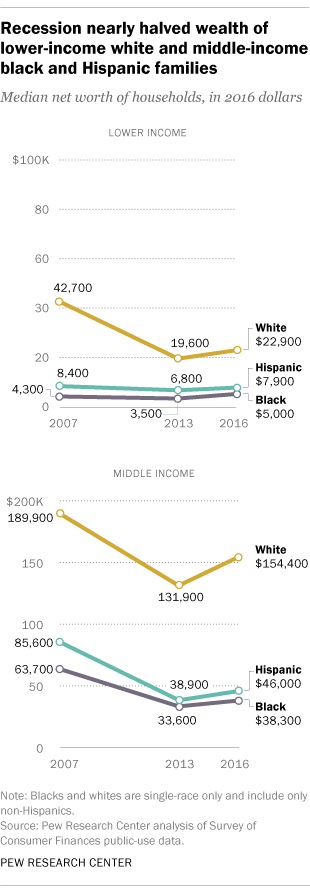
ane Amidst lower- and middle-income households, white families have 4 times equally much wealth as blackness families and three times as much every bit Hispanic families. In 2016, lower-income white households had a net worth of $22,900, compared with only $five,000 for blackness households and $seven,900 for Hispanic households in this income tier. To some degree, this reflects differences in homeownership rates amongst families – 49% for lower-income whites, versus 31% for lower-income blacks and xxx% for lower-income Hispanics. It is also important to annotation that simply 25% of white households are in the lower-income tier, compared with about fifty% each of black and Hispanic households. Thus, low levels of wealth are much more prevalent among black and Hispanic households than among white households.
About the same level of wealth inequality exists among middle-income households. White households in the middle-income tier had a median cyberspace worth of $154,400 in 2016, compared with $38,300 for middle-income blacks and $46,000 for middle-income Hispanics. Homeownership rates among eye-income blacks (53%) and Hispanics (60%) are also less than amid heart-income whites (76%). Half of white households, 42% of blackness households and twoscore% of Hispanic households are in the middle-income tier.
2 Lower-income white families experienced greater losses in wealth during the recession than lower-income black and Hispanic families did. Prior to the recession in 2007, lower-income white families had 10 times as much median wealth equally lower-income black families – $42,700 versus $four,300 (figures in 2016 dollars). Lower-income Hispanic families had a median net worth of $eight,400, lagging white families by a ratio of five-to-one.
These big wealth gaps were trimmed roughly in half by the Groovy Recession, which cut the median wealth of lower-income white households to $21,900 in 2010, a loss of 49%. Losses for lower-income blackness and Hispanic households were much smaller, 3% and 5%, respectively. The larger losses for lower-income white families may take arisen from their greater exposure to the housing market crash. In 2007, 56% of lower-income whites were homeowners, compared with 32% each of lower-income blacks and Hispanics. The homeownership rate among lower-income whites has trended downward since then, falling to 49% by 2016, but the charge per unit for blacks and Hispanics is largely unchanged.
3 The share of lower-income white households that take no wealth or are in debt was college in 2016 than in 2007, but the contrary is true amidst lower-income black and Hispanic households. A corresponding sign of recession-induced stress on household portfolios is the share of families with zero cyberspace worth or in debt. This share edged upwards among lower-income white families, from 14% in 2007 to 17% in 2016. Meanwhile, the share of lower-income blackness families with zip or negative cyberspace worth decreased from 32% to 23% and the share amidst lower-income Hispanic families fell from 23% to fifteen%. In dissimilarity, among middle-income families, the share with zippo net worth or in debt increased from 2007 to 2016, from vi% to nine% among whites, 9% to 18% amid blacks, and 9% to 13% among Hispanics. Overall, black and Hispanic families are more than probable than white families to have aught internet worth or to exist in debt.
4 Racial and indigenous wealth inequality amid eye-income families increased with the recession and has non retreated in the recovery. Middle-income black and Hispanic families took a substantial striking in the recession. The median wealth of heart-income blacks fell to $33,600 in 2013, downwardly 47% from 2007. As well, the median wealth of center-income Hispanics dropped to $38,900 in 2013, a loss of 55% since 2007. Meanwhile, center-income white families experienced a less substantial loss of 31% in this period, every bit their median wealth barbarous to $131,900. Equally a issue, racial and ethnic wealth inequality among middle-incomes families increased during or after the recession. From 2007 to 2013, among those in the center-income tier, the white-to-black wealth ratio increased from three-to-i to four-to-one, and the white-to-Hispanic wealth ratio increased from two-to-one to three-to-i. These margins did not diminish from 2013 to 2016.
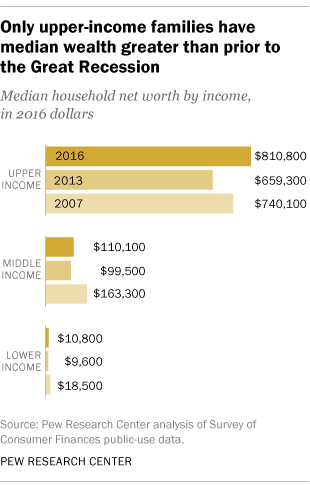
5 Wealth gaps between upper-income families and lower- and middle-income families are at the highest levels recorded. Although lower- and heart-income families overall experienced gains in wealth in recent years, they were not large enough to make up for the losses these families sustained during the recession. Thus, in 2016, the median wealth of lower-income families was 42% less than in 2007 and the median wealth of eye-income families was 33% lower. Indeed, the net worth of these families in 2016 – $10,800 for lower-income families and $110,100 for heart-income families – was comparable to 1989 levels.
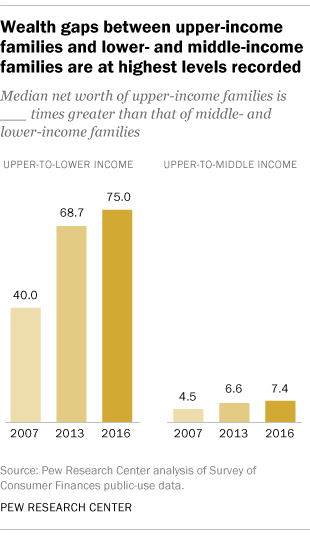
The experience of upper-income families is markedly unlike. Their losses in the recession were smaller and their recovery was stronger. Past 2016, upper-income families had a median wealth of $810,800, 10% more than than prior to the recession in 2007. Moreover, the median wealth of upper-income families is at the highest level since the Federal Reserve started collecting these information in 1983. Consequently, the recession drove wealth inequality between upper-income families and lower- and middle-income families to the highest levels recorded. In 2016, the median wealth of upper-income families was 7 times that of middle-income families, a ratio that has doubled since 1983. Upper-income families also had 75 times the wealth of lower-income families in 2016, compared with 28 times the wealth in 1983.
6 Upper-income white families take grown wealthier. Amid upper-income families, white households had a median net worth of $971,500 in 2016, notably higher than the overall median for this income tier. Moreover, the median wealth of upper-income white families in 2016 was 25% greater than its pre-recession level, an increase greater than for all upper-income families combined.
There is likewise a growing separation in wealth amidst white households past income tier. In 2016, upper-income white families had six times as much wealth as heart-income white families, compared with four times every bit much prior to the recession. Upper-income white families also had 42 times the wealth of lower-income white families in 2016, compared with eighteen times the wealth in 2007.
Overall, the land of wealth inequality by race, ethnicity and income level helps explain why Americans say by a margin of ii-to-one that the economic arrangement in this country unfairly favors powerful interests. The same Pew Research Center survey too finds a racial and ethnic split on how Americans view economic inequality: Blacks (65%) and Hispanics (55%) are more than likely than whites (42%) to encounter economic inequality every bit a very big problem in the country. About one-in-v or fewer whites, blacks or Hispanics view economical inequality as either a small problem or not a problem.

Anthony Cilluffo is a erstwhile research analyst who focused on social and demographic trends at Pew Research Center.
Source: https://www.pewresearch.org/fact-tank/2017/11/01/how-wealth-inequality-has-changed-in-the-u-s-since-the-great-recession-by-race-ethnicity-and-income/

Post a Comment for "How Do Families With Modest Incomes Acquire Wealth"